
Special Agents
Assigned per system, never mixed or substituted
F3B cleaner, F1 protector and F8 coil cleaner-sanitizer: three agents each cover one stage; clear boundaries protect the system.
Product Overview
Three agents, each in its place
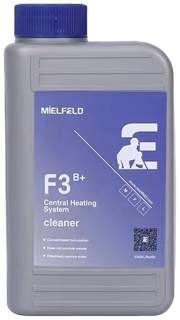
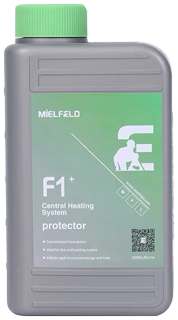
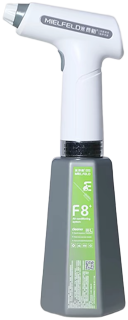
Agent roles
Each one's job
F3B heating-circuit cleaner
A complex system that dissolves and removes scale; for closed heating systems such as floor heating coils, wall-hung boilers and heat-pump circuits.
F1 heating-circuit protector
Dosed after cleaning; forms a dense film that inhibits corrosion and re-scaling; near-neutral, also protects gaskets.
F8 coil cleaner-sanitizer
For sprayable, rinseable open surfaces of AC indoor units — coils, drain pans, fan wheels; decontamination + sanitation; not for piping interiors.
Composition & mechanism
Ingredients disclosed, boundaries stated
| Agent | Main composition (manufacturer figure) | Mechanism | Where used |
|---|---|---|---|
| F3B⁺ cleaner | EDTA chelating agent, citric acid, surfactant, penetrant, dispersant, corrosion inhibitor | Chelates and dissolves scale and rust products, decomposes biofilm, then flushed with circulating water | Closed heating systems: floor heating coils, wall-hung boilers, heat-pump circuits |
| F1⁺ protector | BTA (benzotriazole), sodium molybdate, zinc sulfate, film former | Adsorbs on the metal surface forming a dense protective film; inhibits corrosion and scaling; near-neutral, protects gaskets | Dosed after cleaning for daily heating-system maintenance |
| F8 sanitizer | Benzalkonium chloride, sodium hydroxide, surfactant, penetrant, corrosion inhibitor | Strong-alkali saponification of grease + surfactant stripping of dust, plus surface sanitation | Open surfaces of AC indoor units ONLY (coils, drain pans, fan wheels); never inject into any piping |
Ingredient systems follow the manufacturer's public data; exact ratios are proprietary process information. F8 is strongly alkaline — power off, wear eye protection and alkali-resistant gloves, spray, dwell a few minutes, then rinse with water or steam.
Application boundary
Why F8 must not go into piping
F8 is a coil cleaner-sanitizer for open, sprayable, rinseable surfaces such as AC indoor-unit coils, drain pans and fan wheels. Floor heating coils, radiator interiors, wall-hung boiler and heat-pump water sides, condensate pipes and liquid-cooling plate channels — in short, piping interiors — must not use F8.
The reason is clear: pipe inner walls are a composite of scale + rust products + biofilm that needs dissolution plus fluid shear; F8 excels at saponifying grease but is basically ineffective on scale, and pipe systems contain aluminum, copper alloys and seals with no rinsing path in closed systems, so residue lingers and can be harmful. For piping interiors use: micro-bubble / power circulation physical cleaning, and if needed F3B circulation → rinse → F1 protection.
Usage order
Clean first, protect after
- 01
F3B circulation cleaning
Dose F3B by water volume, power circulation for the set time; acidic system — control concentration and contact time on aluminum parts.
- 02
Rinse & displace
Circulate clean water until near neutral; outlet visually clean.
- 03
F1 film protection
After rinse, dose F1 and run to form the film. Order cannot be reversed: without protector after cleaning, the activated metal surface exposed to oxygenated water can corrode faster.
FAQ
Agent use
Can the three agents substitute for each other?
No. F3B is the heating-circuit cleaner, F1 is the heating-circuit protector, F8 is the coil cleaner-sanitizer; their roles differ. Dealer training and bid documents follow this wording.
What is used to sanitize a circulating-water system?
For microbial control in open circulating cooling water, use a dedicated water-treatment sanitizer (oxidizing / non-oxidizing, alternated); F8 is not used.
Need a quote or a solution?
OEM/ODM export · 3-year full-machine warranty